VSF DateJust 36 Wimbledon (126234) V2 — The Sleeper Pick of 2026
“Best 36 mm datejust?” — that’s the literal text of a post that went up on r/RepTime last week. Pulled in real engagement fast. Scrolling through the responses, I noticed something off: most of the rep community had been hammering 41mm Datejusts for the last two years, and nobody really had a good answer for the 36mm crowd. The big rep evaluation sites? Mostly silent. Factory comparison videos? Almost all 41mm.
That’s a gap.
And for once, it’s a gap filled by a watch that doesn’t get talked about enough — the VSF DateJust 36 Wimbledon (126234). With the V2 upgrade earlier this year, it quietly became one of the best value picks in the entire VSF lineup. Here’s why.
Why “best 36mm Datejust” is suddenly a search trend
For a long stretch of 2024-2025, 41mm Datejusts were the default. Bigger watches, more wrist presence, the cultural moment of the post-COVID “everyone is a watch guy” phase. The 36mm felt small by comparison and got pushed aside as a women’s watch in the rep community.
That’s flipped.
Look at what’s happening in the last six months:
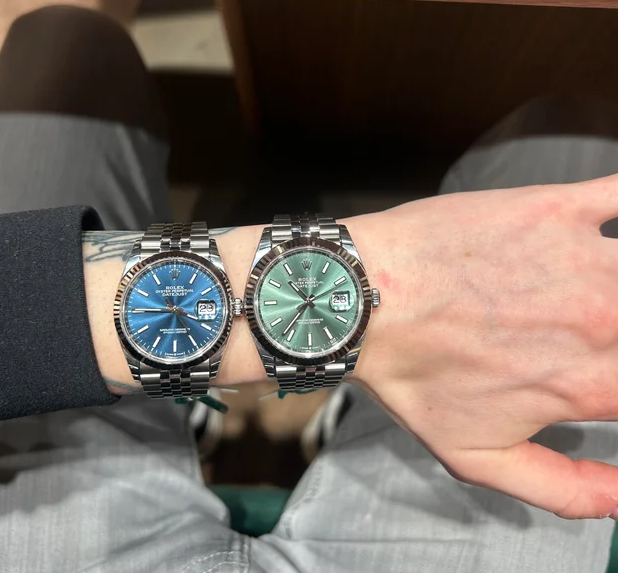
- Guys with 16cm and below wrists are openly preferring 36mm because it actually fits
- The vintage and “neo-vintage” aesthetic is back — and 36mm has the proportions for it
- Rolex itself launched its modern 36mm Datejust lineup with the same V2-era movements as the 41mm
- The 36mm Wimbledon (grey dial, red Roman numerals) became the watch influencers started wearing without saying it was a rep
Honestly, when someone posts “Best 36mm Datejust?” on Reddit, they’re not asking a niche question anymore. They’re asking the same thing half the new buyers are quietly asking. And the answer most reviewers are missing is: VSF, V2, 126234 reference, Wimbledon dial.
The 36mm vs 41mm decision — and why wrist size is the only thing that matters
This part is simple but gets complicated by people pretending it’s a style preference. It isn’t. It’s anatomy:
| Wrist circumference | Recommended size | Why |
|---|---|---|
| Under 6.3″ (16cm) | 36mm | 41mm will overhang and look toy-like |
| 6.3″ – 6.7″ (16-17cm) | 36mm or 41mm | Personal preference, either works |
| Over 6.7″ (17cm) | 41mm | 36mm will look undersized |
Quick reference point — a 5’9″ / 130 lb (175cm / 60kg) build typically lands in the 36mm zone. The 41mm starts to feel right around 5’11″+ with a corresponding wrist. There’s nothing masculine or feminine about either size. It’s purely how the watch sits on your specific wrist.
Had a client in Boston last March, 16.5cm wrist, kept going back and forth between the two. He ended up doing what I now tell everyone — ordered both sizes from the same TD, wore each one for a week, sent the loser back. Cost him a small restocking fee. Saved him a year of “did I pick wrong?”
If you can’t try them on, measure your wrist with a tape measure (not a ruler — wrap it around the bone, snug not tight) and go from there.
What the V2 upgrade actually fixed
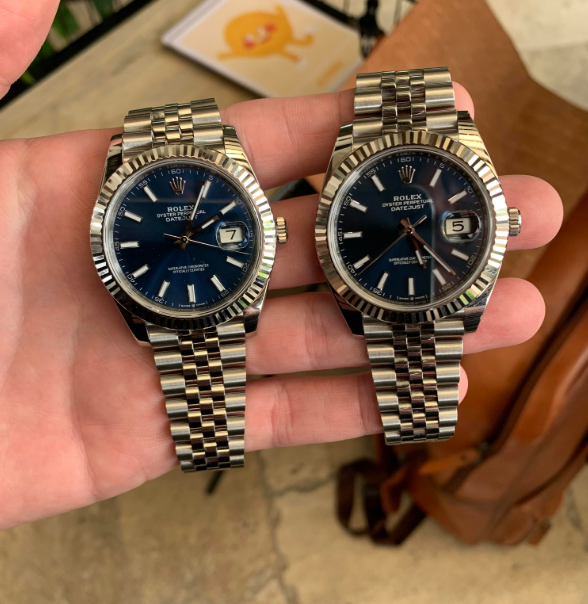
For most of 2024 and into 2025, VSF’s 36mm Datejust lagged behind their 41mm. The 41mm got the V2 treatment first — newer rotor bearing, refined dial application, weight tuning. The 36mm was stuck on V1 with a 115g weight (versus the genuine’s 121g) and the older 7-ball rotor bearing.
That’s where most of the older Reddit reviews come from. They’re reviewing the V1, which had real shortcomings.
The V2 landed in early 2026 and changed the conversation.
What V2 brought to the 36mm:
- Weight: 120g (versus 121g genuine) — basically indistinguishable on the wrist. V1 was 115g, which you could feel as “lighter than expected.”
- Movement: Dandong 3235 V2 — 27-jewel rotor bearing (V1 had 7 jewels). The 27-jewel design is what’s actually in genuine modern Rolex movements. Smoother winding, quieter rotor, longer service interval.
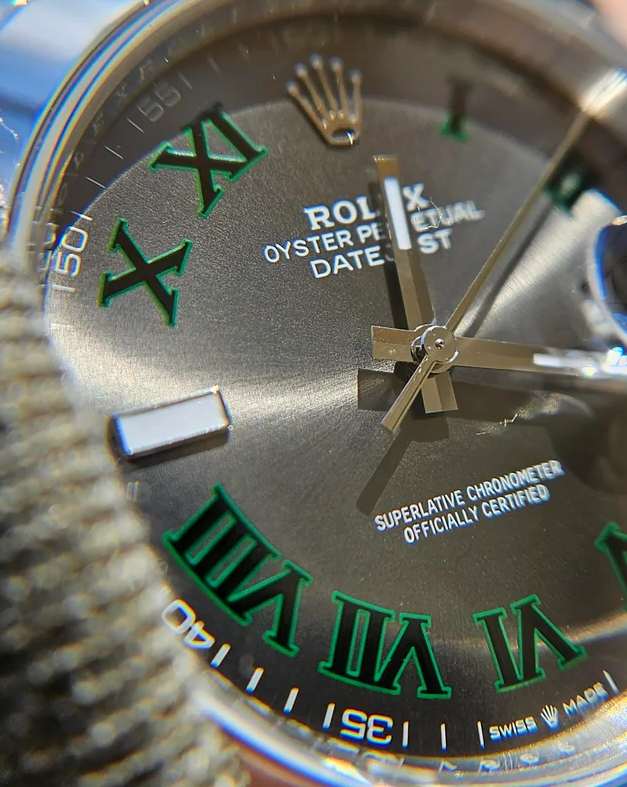
- Dial precision: improved oil-printing — under 30x macro inspection, the V2 dial has minimal ink runoff at character edges. V1 had visible ragged edges under macro.
- Clasp code: F6U with flat-top A — VSF caught up to the genuine clasp engraving. Older V1 clasps had a slightly different code.
- Anti-counterfeit dots — four security dots below the olive marking on the clasp, matching current genuine production.
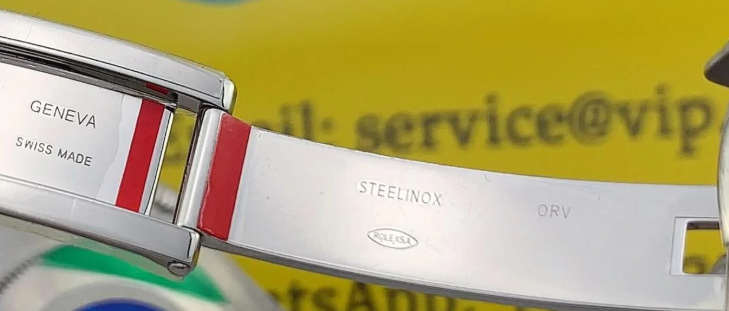
I’ve personally handled both V1 and V2 side by side. The jump is real. Not a hidden internal change — a perceptible quality jump you can feel before you even put it on.
If you’re shopping right now, the only question to ask the dealer is “is this the V2?”
If they hedge or don’t know, find another dealer.
The Wimbledon dial — what makes it special
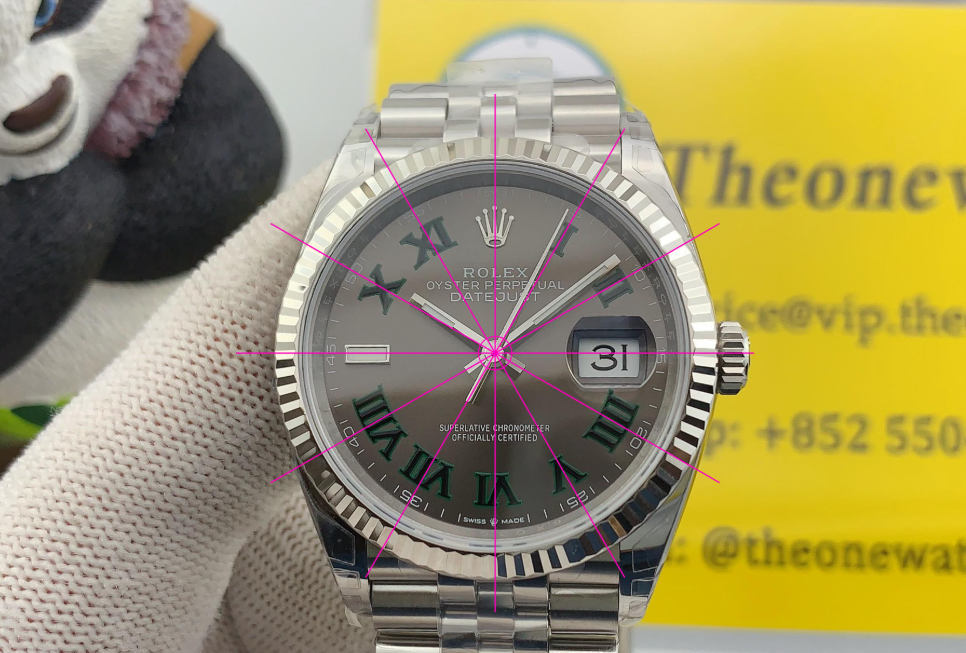
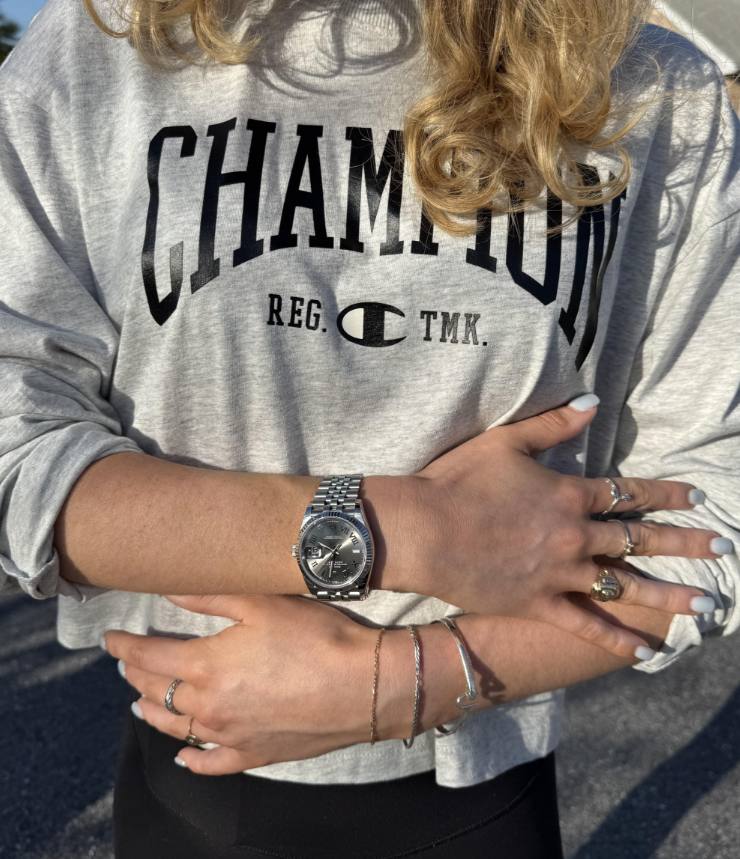
The Wimbledon Datejust is a specific dial configuration: dark grey “rhodium” dial with red Roman numeral hour markers and the classic Datejust hand stack. It picked up the nickname “Wimbledon” because of the green-and-white-and-red color story Rolex carried at the actual Wimbledon tennis tournament — though Rolex never officially calls it that.
What makes it work:
- Contrast that pops — red on grey is dramatic without being loud. Office, dinner, gym — all fine.
- Patina-friendly — the grey dial ages gracefully. No yellowing or color shift like white dials get over time.
- Photographs well — for anyone posting wrist shots, the Wimbledon survives social media scrutiny better than most.
- Less common in real life — the white-on-white DJ36 is everywhere. The Wimbledon stands out without screaming.
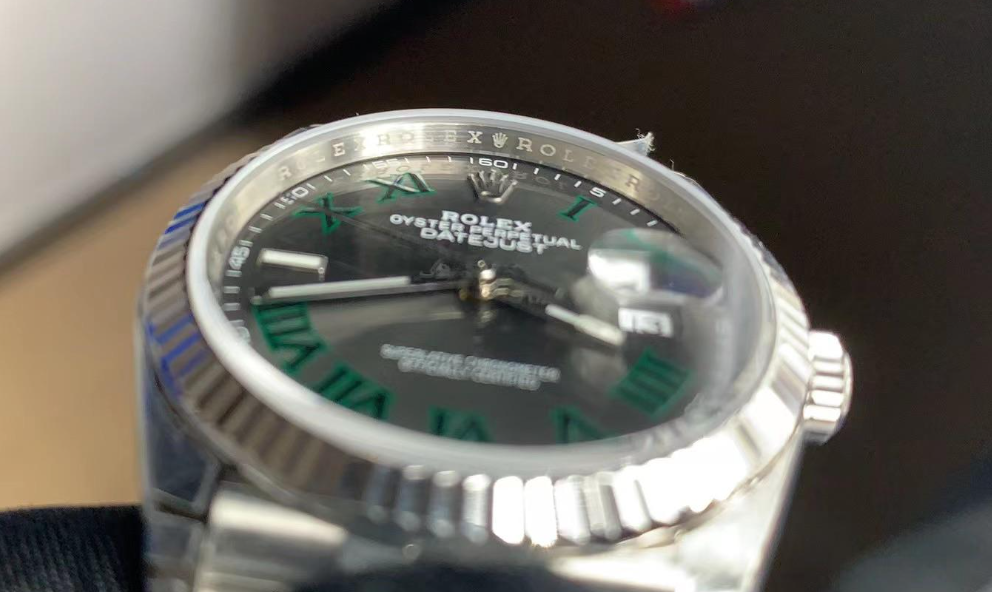
VSF’s execution of the Wimbledon dial is accurate. The grey shade matches current genuine production — and this matters, because Rolex has shipped slightly different grey tones over the years. The VSF V2 matches the 2022+ batch. The red Roman numerals are well-printed with crisp edges. Chapter ring proportions are correct.
The DD3235 V2 — what the 27-jewel rotor actually means
The “V2” designation on the Dandong 3235 isn’t marketing. It’s a real mechanical upgrade.
The V1 Dandong 3235 used a 7-ball rotor bearing — seven small ball bearings supporting the rotor’s circular motion. It works, but it’s not what genuine Rolex uses, and the wear pattern is different.
The V2 went to a 27-jewel synthetic ruby bearing — matching the genuine Caliber 3235 architecture.
The benefits aren’t headline-grabbing. But they’re real:
- Quieter rotor — less audible “hiss” when winding
- Smoother rotor coast — the rotor spins longer per flick before stopping
- Longer service interval — the 27-jewel design wears more evenly
- Higher amplitude on timegrapher — typically 5-10° better than V1
Bottom line: if you’re buying a VSF anything in 2026, confirm it’s V2. Some dealers are still clearing V1 stock at a discount, and the discount isn’t always worth the older bearing design. The V1 isn’t bad — it just doesn’t match what current genuine production looks like.
VSF DJ36 vs the alternatives — Clean (R.I.P.), V Factory, others
For the 36mm Datejust specifically, the mid-2026 landscape:
- VSF DJ36 V2 (Dandong 3235 V2) — Active production, current generation, V2 throughout
- V Factory DJ36 — The successor to Clean Factory’s old team. Uses some Clean-era tooling, mid-shell code “6R” matches Clean’s old 41mm code (suggesting recycled parts). Clasp still uses the older sharp-top A engraving. Production is irregular as of May 2026.
- Clean DJ36 (old stock) — Limited inventory at TDs, no warranty path beyond original dealer
- Generic Shanghai 3235 versions — Cheaper, 50h power reserve, identifiable by clasp differences
The V Factory situation is worth understanding. After Clean shut down, the original Clean team reformed under the “V” name and started producing watches with some refinements. For the 36mm specifically, V Factory has been making progress — but the recycled tooling shows in inconsistent details. A buddy of mine in Florida picked up a V Factory DJ36 back in February, sent me the QC pics, and sure enough the mid-shell case code was the old 6R that belonged to Clean 41mm production. Not a deal-breaker. But a tell that some details weren’t fully redesigned.
If you specifically want a Clean DJ36, you can still find them at some TDs — but you’re buying inventory with no warranty path.
VSF V2 is the safer pick.
Pricing — what to expect in 2026
Dealer pricing for current VSF DJ36 V2:
| Dial / Bezel option | Dealer floor | Typical street price |
|---|---|---|
| Wimbledon (grey + red Roman) | $420 | $480-560 |
| White Roman | $420 | $480-560 |
| Champagne / silver | $420 | $480-560 |
| Blue Ombre | $440 | $500-580 |
| Green Ombre (Reddit-favored) | $440 | $500-580 |
| Stick markers (any dial) | $420 | $480-560 |
The pricing is roughly $50-100 below the equivalent 41mm Datejust, mostly because the 41mm has historically had more demand. That gap is narrowing as 36mm gains traction — but right now it works in your favor. Same VSF V2 movement, same dial quality, smaller case, lower price.
One warning.
If you see VSF DJ36 listed under $400, treat it like any other suspicious price — probably a generic Shanghai 3235 in a VSF-style case. Real VSF dealer floor is around $420.
Common Questions
Is the 36mm too small for a male wrist?
Only if your wrist is over 17cm. Below that, the 36mm fits naturally. There’s a generation of guys who grew up with bigger watches and assume 36mm is “feminine” — that’s a cultural assumption, not a fact. The original Datejust was 36mm and it was unisex from launch.
Will the Wimbledon dial age well or yellow over time?
Grey dials don’t yellow. The dial color is rhodium-finished, which is chemically stable. The red Roman numerals are oil-printed and will hold their color for many years. One of the more long-term-friendly dial choices in the lineup.
Should I get the Oyster or Jubilee bracelet?
Jubilee is the more iconic pairing with the Wimbledon dial — Rolex shows it with Jubilee in their own marketing. Oyster looks slightly more sporty. Both are well-executed by VSF. Personal preference, but my pick is Jubilee for this specific dial.
Can the VSF DJ36 be serviced by a regular watchmaker?
The Dandong 3235 is mechanically very close to the genuine 3235, so any watchmaker who works on real Rolex can service it — assuming they’re willing to touch a rep, which most won’t openly admit but some quietly will. Service cost should be $100-180 for a clean and oil.
What’s the actual return rate on VSF DJ36 V2?
Approximately 1-2% based on dealer reports. On par with VSF Submariner, which is the lowest in the industry. The Dandong 3235 V2 movement is reliable. Case finishing has been consistent across batches.
Can I customize the dial color or bezel after ordering?
Most TDs can swap dials between the standard VSF options pre-shipment. Custom dials (after-market enamels, weird color combinations) usually aren’t supported — VSF won’t void warranty on dialed-up modifications.
Ray’s Verdict
VSF DJ36 Wimbledon V2 (126234) — Final Score
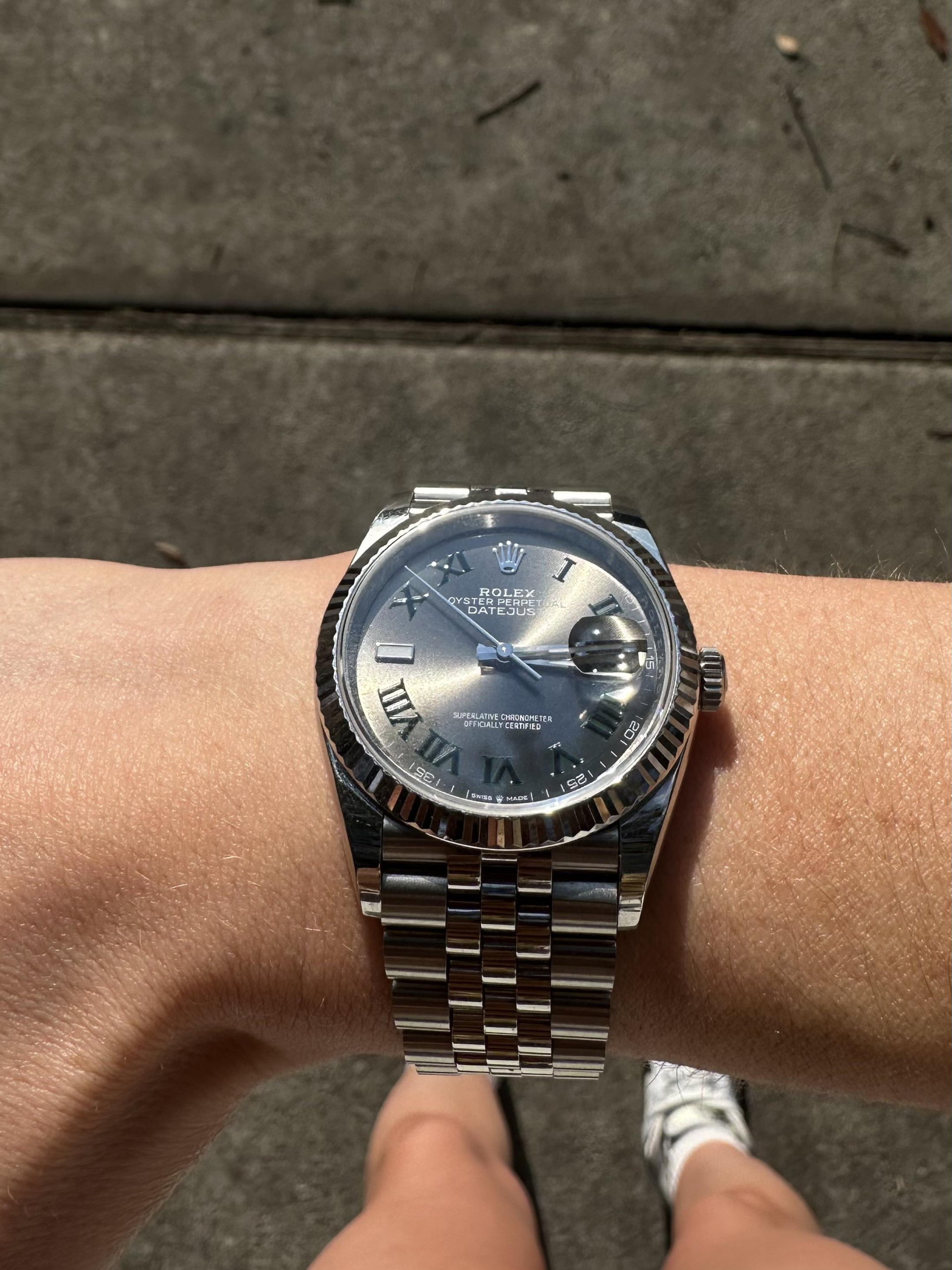
Case & Dial: 9.2 / 10 — Wimbledon dial color matches current genuine production, red Roman numerals crisply printed, case finishing is precise
Movement (Dandong 3235 V2): 9.4 / 10 — 27-jewel rotor bearing, 70h power reserve, lowest service rate in segment, matches genuine 3235 architecture
Build Quality: 9.0 / 10 — F6U clasp code matches genuine, anti-counterfeit dots in place, 120g weight basically identical to genuine 121g
Value for Money: 9.3 / 10 — $480-560 street, the sleeper value pick in the entire VSF lineup right now
Overall: 9.2 / 10